

The Woodbine Mile presented a familiar handicapping problem: the two most likely winners were obvious, but betting both of them would erase the advantage we were trying to find.
After scratches, only six horses remained in today’s Grade 1 Woodbine Mile. The race is eight furlongs on firm turf, with a very high 4.5 wagering-confidence score and a neutral Pace 5. Charting Horse Value made #1 Deterministic the clear model leader, but the important part was turning that ranking into a disciplined ticket.
Watch the full Race of the Day video for the complete horse-by-horse analysis.
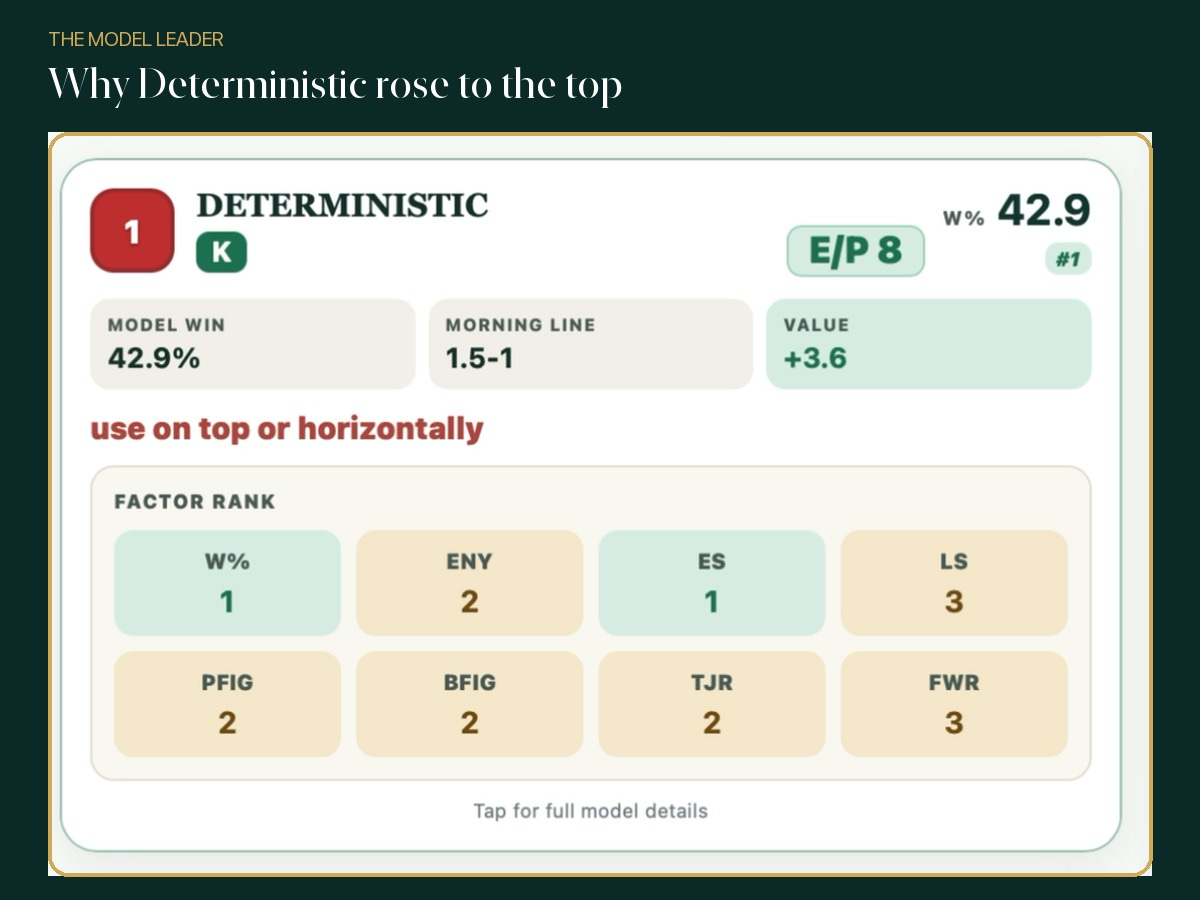
Start with modeled win probability—then compare the price
CHV gave Deterministic a 42.9% modeled win probability, a K grade, and positive Value against his 1.5-to-1 adjusted morning line. He also ranked first in Early Speed and second in Energy, PFIG, BFIG, and Trainer/Jockey Rating. That is the profile of a horse we can confidently build around.
The main danger was #3 Notable Speech, with a 28.1% modeled win probability and excellent performance figures. Together, Deterministic and Notable Speech accounted for roughly 71% of the model’s win probability.
That did not mean we should use both equally.
Notable Speech’s adjusted morning line was 7-to-10, while CHV’s fair-odds estimate was closer to 2.6-to-1. He was a strong contender at a price the model considered far too short. Deterministic offered the better balance of win probability and price.
The most famous horse, the morning-line favorite, and the best wager are not always the same horse.
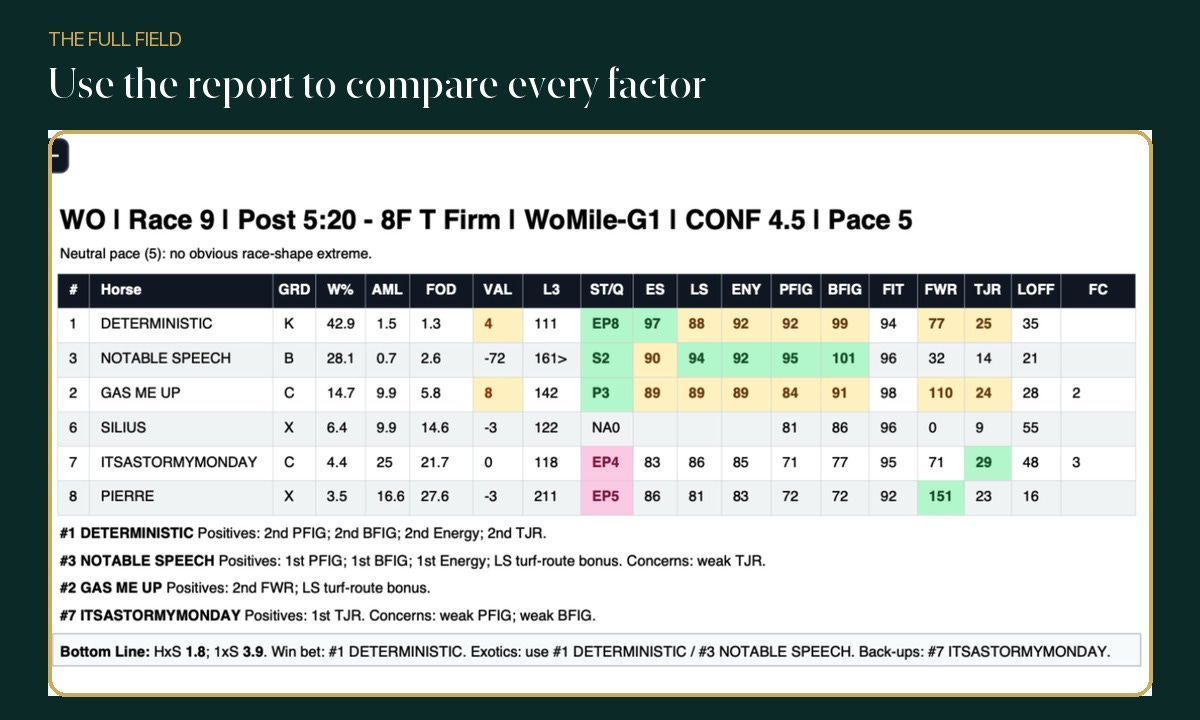
Use the other factors to decide where each horse belongs
Once the top two were identified, we used CHV’s other factors to decide how to structure the wager.
Late Speed is especially important in a Grade 1 turf route. Notable Speech owned the best Late Speed in the field, which made him difficult to leave out completely. His price made him unattractive on top, but his finishing ability still made him the strongest horse to use underneath Deterministic.
#2 Gas Me Up ranked second or third across the major factors, had positive Value, and owned the second-best Late Speed. His Energy rating was 3.3 points behind the leader—close enough to remain relevant, but not strong enough for us to view him as the likely winner. That made him an underneath horse.
#6 Silius was harder to measure. The European shipper did not have competitive CHV speed figures, but unfamiliar form creates uncertainty. We kept him as a smaller underneath possibility.
At the other end of the field, #7 Itsastormymonday was 7.6 Energy points behind the leader and had only a 4.4% modeled win probability. #8 Pierre looked outclassed. Those were the kinds of horses we wanted to remove from the main ticket.
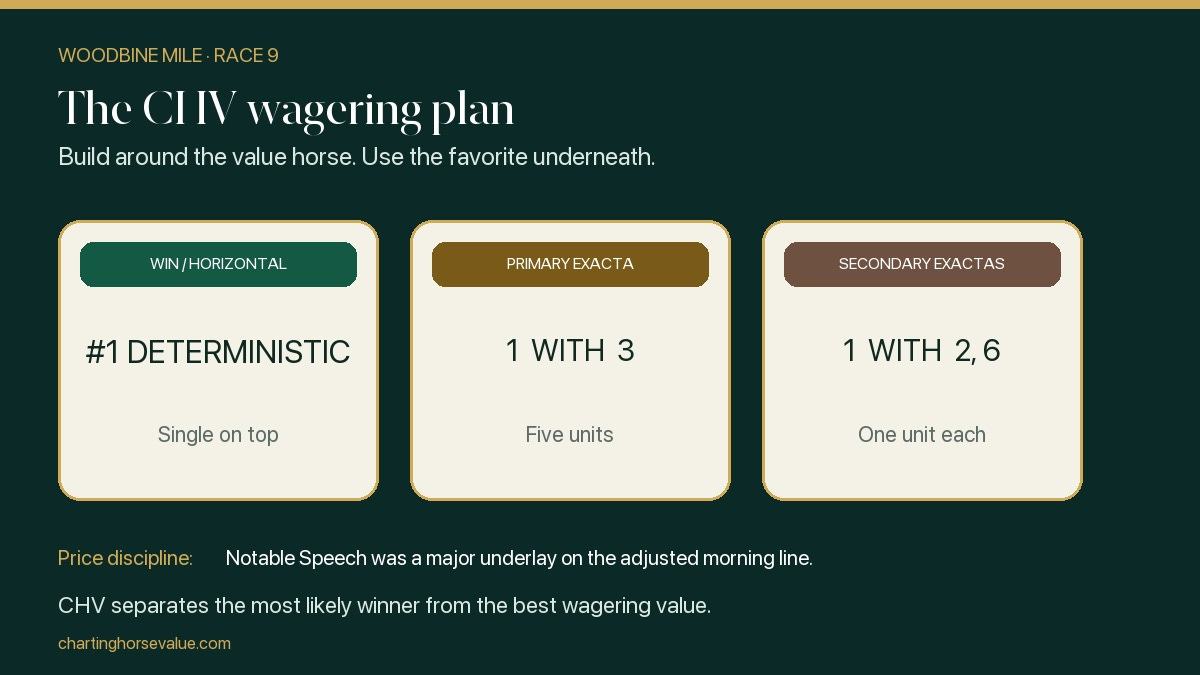
The final Woodbine Mile wagering plan
The software organized the field. The final ticket still required a handicapping decision.
Our stand was to use Deterministic as the single on top and in horizontal wagers. We would fade Notable Speech from the win position, while respecting his Late Speed underneath.
Win and horizontal wagers: single #1 Deterministic
Primary exacta: five units on 1 with 3
Secondary exactas: one unit each on 1 with 2 and 1 with 6
The five-to-one weighting between the primary and secondary exactas reflects conviction. We did not want three equal tickets that treated every underneath horse as equally likely. Notable Speech was clearly the most dangerous runner, so the 1–3 combination deserved the largest share of the exacta budget.
Post-time odds still matter. If Deterministic’s price falls well below fair value, the win bet becomes less attractive even though he remains the model’s most likely winner. CHV helps identify the horse; wagering discipline determines whether the available price justifies the bet.
Four lessons from the process
Begin with W%, but do not stop there. Modeled win probability establishes the hierarchy. Value tells us whether the market price offers an opportunity.
Do not use every logical horse in every position. Notable Speech was a legitimate contender, but his short price pushed him underneath rather than on top.
Weight combinations according to conviction. A five-unit primary exacta and one-unit secondary exactas express the analysis more accurately than equal bets.
Use uncertainty selectively. Silius was difficult to measure, so we used him defensively underneath.
That is the goal of Charting Horse Value: reduce a complicated field to a small number of informed decisions, then build a wager that reflects both probability and price.
Watch the complete Woodbine Mile Race of the Day video for the full horse-by-horse walkthrough, factor comparisons, and ticket construction.
Visit the Races of the Day page for the video, key moments, transcript, and prior CHV race analyses.
Get the analysis—and the full CHV app
Subscribe free to receive new CHV articles and race-analysis videos by email.
Monthly and annual paid Substack subscribers receive full access to the Charting Horse Value app, including updated race cards, modeled win probabilities, Value, factor rankings, personal notes, past dates, and downloadable handicap reports.
Choose a free or paid subscription or open the Charting Horse Value app.
— Jeff Bessa
Founder, Charting Horse Value
Race conditions, scratches, and odds can change. CHV analysis reflects the information available when the video was recorded.